



 Get in touch
 Log in




Instagram reaches over 2 billion monthly active users, and ad spend on the platform grew 21% year-over-year in Q3 2025, according to a recent digital ads benchmarking report by Tinuiti. Brands are pouring more money into Instagram than ever before. But more spend doesn’t automatically mean better results.
The gap between what the platform can deliver and what most campaigns actually generate often comes down to the same handful of problems.
- Outdated creative approaches
- Poor measurement infrastructure
- Ad accounts that aren’t structured to let Meta’s algorithm do its job
In this guide, we walk you through the best practices that can help you address these issues and get more out of your Instagram ads.
14 Instagram ad best practices to improve your ROAS
These are our best practices to help you make the most out of your Instagram ad budget.
1. Get Meta Verified
That blue checkmark next to your brand name is not just about looking official. Being Meta Verified means you get protection from impersonation and priority access to Meta support. But potential customers also trust you more, as they’ll consider your account legitimate. If you’re in a competitive or trust-sensitive industry like beauty, luxury or fintech, this matters.
Think of it as laying the trust infrastructure before you start scaling spend.
To apply, go to Meta Business Suite, navigate to settings and look for the Meta Verified tab. You’ll need a government-issued ID and an active business presence to get verified.
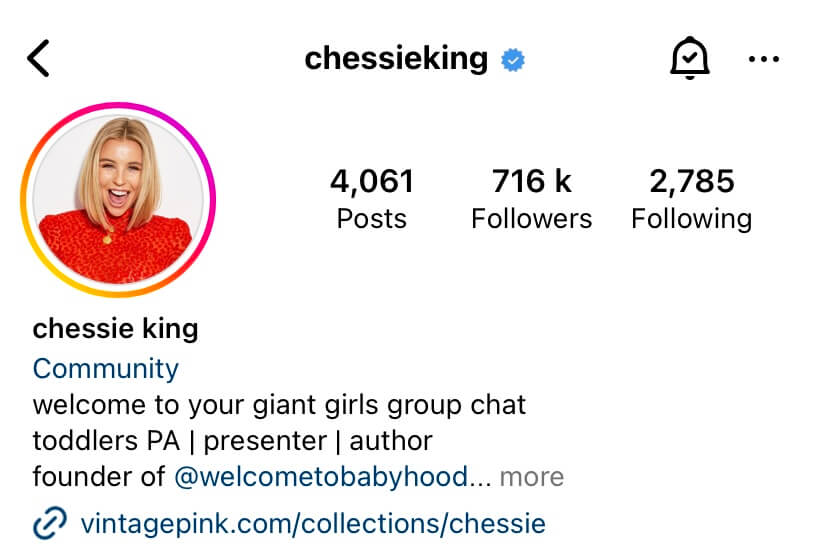
Example of a verified profile on Instagram
2. Build a structured creative testing framework
Testing is a critically important part of any good ad campaign, and Instagram advertising is no exception. Test the ad format by following the variables until you find the ad format that works best for you:
- What to test: Ideally, you should look at five variables within your ads: the hook (your opening one to three seconds), the format and placement (Reels vs. Feed vs. Stories), the offer or CTA, the video length and the audience segment. Changing multiple variables at once might feel faster, but it muddies the data. If your new ad outperforms the old one, you want to know why.
- How to structure tests: Meta’s built-in A/B test tool in Meta Ads Manager makes this easier than building a manual split. You need to set a clear hypothesis before you launch. For example, “We believe a question-based hook will outperform a bold-claim hook for our DTC audience.” Run the test for a minimum of seven days and make sure each variant has enough budget to generate at least 100 conversions. That’s when you’ll be able to trust the results, so resist the urge to kill a test early because it feels like one test is pulling ahead after 48 hours.
- How to feed learnings back: The real value of a testing framework is in the compounding library of knowledge you build over time. Start by documenting your winners. For instance, catalog which hooks, formats and offers consistently outperform and then use those proven elements as the baseline for your next round of experiments. Refresh your creative on a regular cadence to experience lower ad fatigue and more sustained performance.
- A/B test different offers: To take your product offering a step further, use discounts and sales — who doesn’t love a discount? Consumers constantly seek retailers that offer the best value through the entire purchasing process, from the initial search to the final checkout. But to some consumers, cost savings aren’t enough. They want to save on their most precious resource: time. Test out different ad formats and offers that let consumers save money or save time to find out what your custom audience is looking for.
3. Set up measurement infrastructure before you scale
There’s no point in scaling your ad spend without proper measurement mechanisms in place because you’ll waste your marketing budget. Start by adding UTM parameters to your ads. Using consistent UTMs for source, medium, campaign and content will make it easier to measure performance outside of Instagram.
Here are some of the most common UTM mistakes you should avoid:
- Inconsistent capitalization (e.g., “Instagram” vs. “instagram” vs. “IG” breaking your reporting)
- Missing parameters on Story and Reels ad links
- Forgetting to tag Advantage+ auto-generated ad placements
- Using vague campaign names
While assessing ad performance, ask yourself: What revenue did this campaign actually generate that wouldn’t have existed without Instagram?
Instagram will take credit for conversions that would have happened anyway. Every ad platform does this. You don’t need a full testing program on day one, but approach platform-reported ROAS with healthy skepticism. When your measurement data flows through a unified system where Instagram sits alongside every other channel, these questions become much easier to answer.
4. Create on-brand and visually compelling content
Instagram is a visual platform. That means if you’re posting irrelevant, low-quality, or downright boring photos, you’ll get ignored quickly. On the other hand, if you use high-quality images and shopping ads that appeal to your products, you’ll capture potential customers’ attention and encourage them to make a purchase.
In short: visual consistency builds trust, and trust drives conversions.
But consistency doesn’t mean everything needs to look polished. Even lo-fi content shot on a phone can outperform high-production studio work. Here’s an example from Chewy’s Instagram feed:
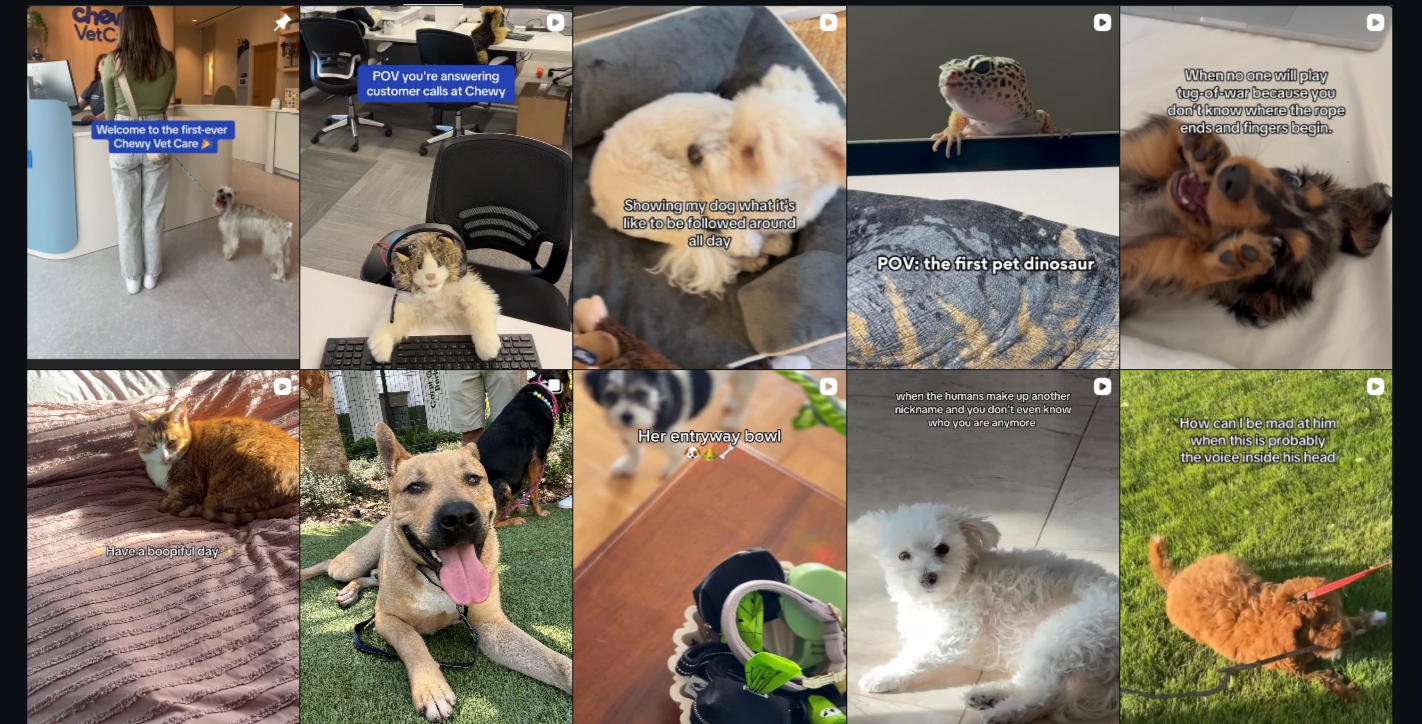
Chewy’s IG feed
Carousels also continue to outperform other formats for views on Instagram regardless of account size according to Social Insider’s benchmark data. If you’re not testing carousel ads alongside Reels and static images, you’re leaving reach on the table.
5. Design for sound-off viewing
Whether on their phones on the train to work, at their kid’s baseball game, while feeding a baby, or any other time when sound is inopportune, it’s critically important to give consumers a way to still consume your content and brand message through Instagram video ads, even with the sound off.
Follow these tips to do so:
- Add closed captions: Whether you’re creating Instagram ads or any other type of video ad, you should always add closed captioning for accessibility. It’s important to keep in mind that some of the people watching your ad may be hard of hearing or deaf, or have sensory processing issues that require them to read along with the video to understand it fully.
- Don’t rely on music to add meaning: There’s a time and place for music, and you shouldn’t depend on music when creating ads. Music, with or without vocals, shouldn’t tell the story. Your ad should stand on its own.
- Focus on showing, not telling: Audiences tend to respond better to ads that show them things rather than tell them through scenes with strong visuals that convey information rather than straight-up telling them what’s going on. The same rule applies to your IGTV ads, stories ads, in-feed ads, carousel ads, and other ad formats on Instagram and beyond. Try challenging yourself to create Instagram ad copy that conveys a message entirely through images, with no sound or captions needed.
6. Learn how to hook viewers
The first three seconds of any Instagram video ad decide whether someone watches or scrolls. This is the hook, and it’s the single highest-leverage element in your creative.
Most advertisers default to opening with their brand name or product shot. But that’s also a reliable way to get skipped. You need to interrupt the scroll to encourage Instagram users to keep watching. Here are a few ways you can do that:
- Pattern interrupt: Something visually unexpected that breaks the feed’s rhythm.
- Bold claim: A specific, surprising statement that makes the viewer want to see the proof.
- Question: Posing a problem your audience recognizes instantly.
- Before/after: Showing a transformation in the first frame.
For instance, Sephora uses ASMR-style videos to earn attention and encourage viewers to engage with their videos. The style itself draws the reader into the video.
Also, always test different hooks and let your data guide which hooks to double down on in the future.
7. Find trends and make them your own
Trending audio, formats and visual styles can increase your ad’s reach because Instagram’s algorithm tends to favor content that aligns with what’s currently performing well. The trick is knowing where to look.
A few places to spot emerging trends:
- Reels tab: Scroll through the Reels feed to see which formats, audio clips and editing styles are getting traction right now.
- Explore page: Instagram’s Explore surfaces content that’s gaining momentum across the platform. It’s useful for spotting visual trends and popular content themes.
- Instagram’s @creators account: Meta uses it to announce new features, highlight trending formats and share creator tips. It’s one of the best first-party sources for staying ahead of platform shifts.
- Competitor monitoring: Watch what other brands in your space are testing. Patterns across competitors can signal broader shifts in what audiences respond to.
- Meta’s Creative Hub: Browse top-performing ad examples across industries and formats for inspiration on what’s working in paid specifically.
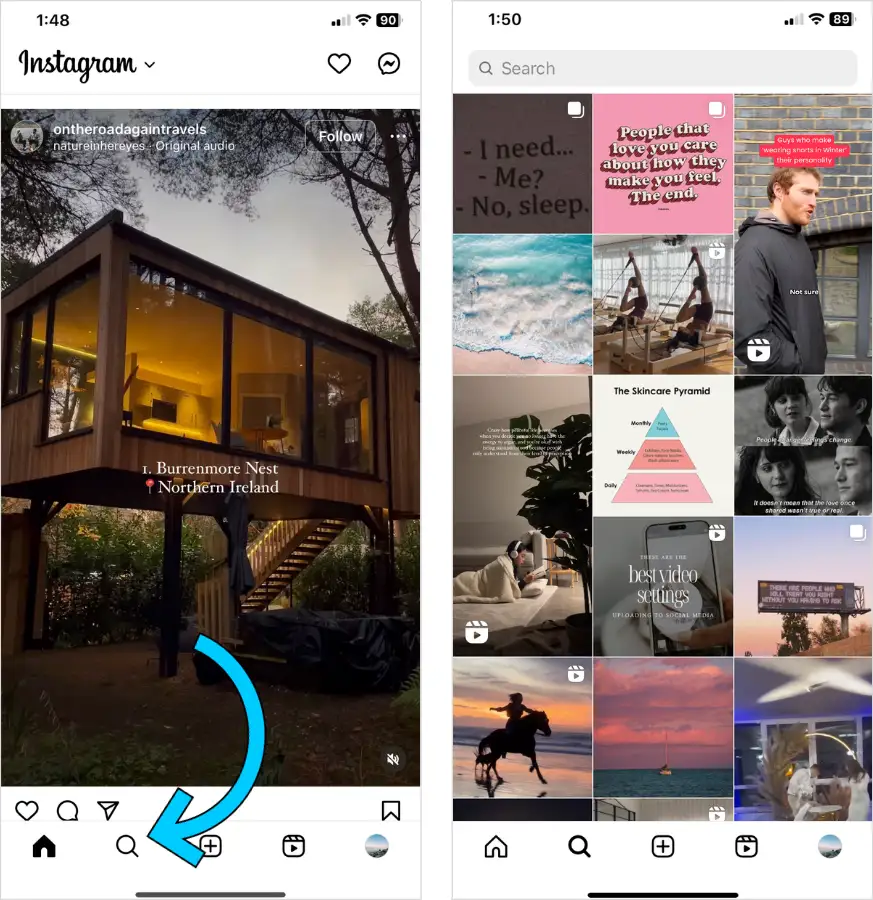
Instagram’s Explore page
8. Try different types of video ads
Consider different video lengths: Although snackable, TikTok-style videos are all the rage right now, that doesn’t mean there’s no audience for long-form videos. If your product fulfills a particularly emotional or special need, your audience may be more compelled to engage with a long-form Instagram video ad that pulls on their heartstrings. If you’re selling something flashier, cooler, or that fits broader needs, a quick, punchy, to-the-point video ad may be what your audience is looking for. But you’ll never know what length of Instagram video ads will resonate deepest with your audience until you test different lengths.
Some types of video ads to try out include:
Animation video ad
Animated videos are a fun way to showcase your brand’s personality while capturing attention. This style of video ad is particularly effective when you need to explain complex products or services in an engaging way.
User-generated content (UGC)
UGC is a powerful way to build social proof and trust. It gives you an excellent opportunity to show how real customers use and benefit from your products and services. UGC outperforms brand-created content in both organic reach and ad performance, and it looks real because it is real. People now feel UGC is 9.8X more impactful than influencer content. UGC is a powerful way to build social proof and trust. It gives you an excellent opportunity to show how real customers use and benefit from your products and services.
Professional videos
When you’re trying to create a high-quality, polished look for your brand, there’s no better choice of video ad than one that’s professionally done. You can hire a professional videographer or work with a creative agency to create videos that stand out from the crowd.
Live videos
Live videos let you connect with your audience in real time while showcasing the human side of your brand. You can host live Q&A sessions to answer questions about your brand and products, helping your audience get to know you more deeply. You can also offer behind-the-scenes tours of your office, factory, design process, and more to help build a strong community around your brand.
Lo-fi videos
It may seem strange, but in our experience, the best ads blend with the user feed and “don’t feel like ads.” So try testing video ads shot on your iPhone and see if they work as well (or better) than videos shot by expensive creative agencies.
9. Don’t forget about Instagram ad safe zones
To make sure your Instagram ad formats are displayed as you intend, it’s important to be mindful of Instagram safe zones.
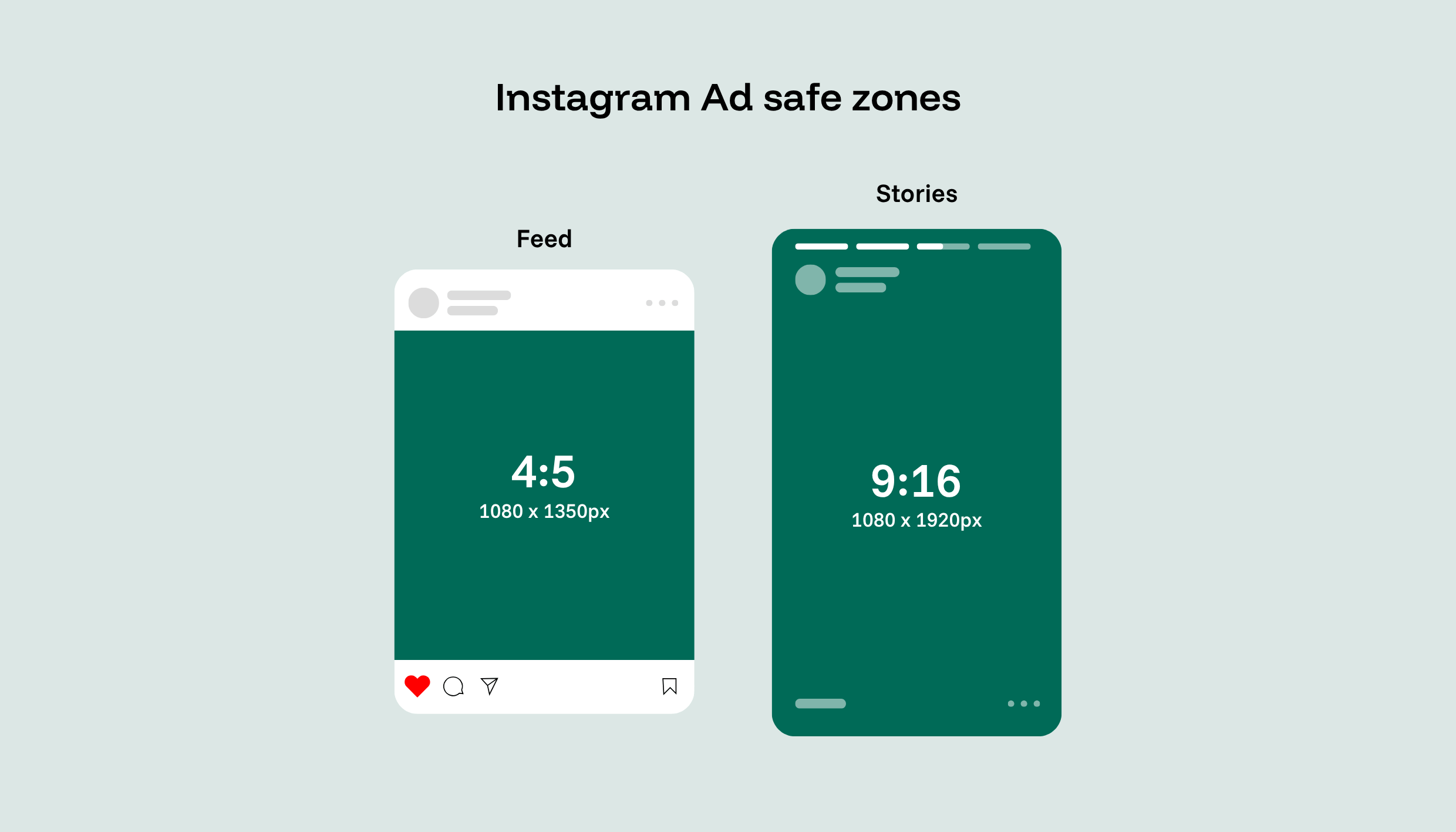
Different placements crop your creative differently, and it changes based on Instagram photo ads and video ads. If your key message or CTA sits outside the safe zone, it gets cut off on certain devices and placements.
10. Use the Meta Conversions API
The Meta Conversions API (CAPI) within Facebook Ads Manager tracks conversions and other key metrics beyond simple web tracking. Browser-based pixel tracking is becoming less reliable with every privacy update. Since CAPI sends event data directly from your server to Meta, it gives the algorithm cleaner conversion signals.
For instance, iOS 14.5+ and ongoing cookie deprecation have made the pixel increasingly unreliable. If you’re still relying on pixel-only tracking, you likely have gaps in your conversion data. And those gaps hurt both attribution accuracy and ad delivery optimization.
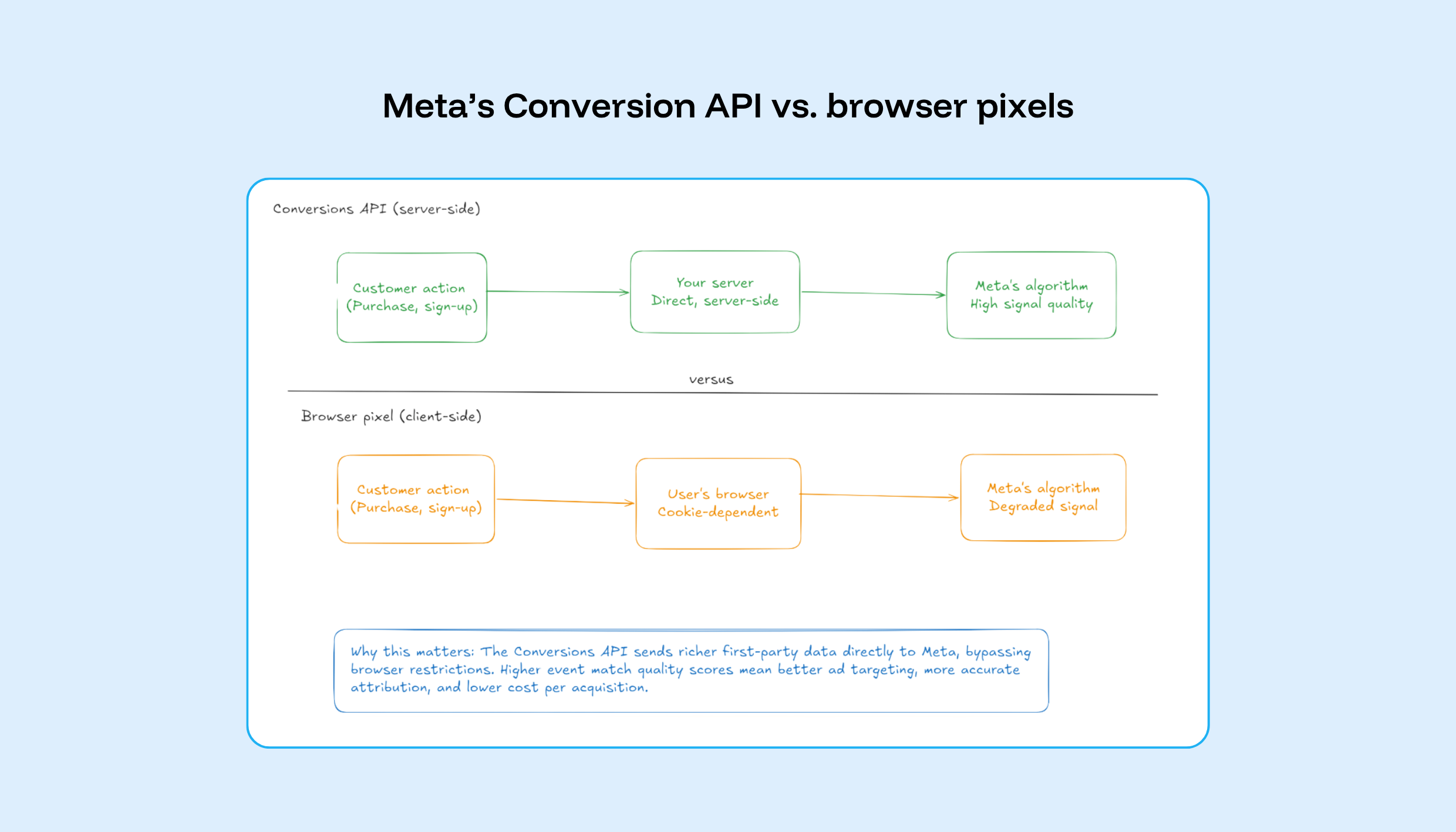
That’s why you should pay attention to your event match quality (EMQ) score. This score measures how well the customer data you send through CAPI matches Meta’s user records. The higher your EMQ, the more confidence you’ll have in your conversion data to make better decisions.
The algorithm is only as good as the signals you feed it. Send it richer, more accurate first-party data through CAPI, and Meta has more to work with when deciding who sees your ads. Eventually, you should have that data flow through a unified system to ensure you’re getting cleaner data to decide whether Instagram is worth the investment.
11. Use broad targeting and Advantage+ to optimize delivery
The Instagram app has a strong algorithm that targets users based on data it’s collected about groups of users. This is an Instagram ad’s best practice because when you target broadly, you let Instagram do the heavy lifting. You rely on them to find the best people to test your Instagram ad formats.
This approach works best if you’re not sure who you should be targeting yet, or if you want to try to expand your reach to new audiences. Explore ads’ broad targeting.
When you target broadly on Instagram, you let the algorithm do the heavy lifting. Instead of manually stacking interest-based audiences, you rely on Meta to find the best people to show your ads to. For instance, Meta’s Advantage+ campaigns automate three things at once:
- Audience selection: The algorithm finds converters without manual targeting inputs.
- Placements: Ads automatically deliver across Feed, Stories, Reels and Explore based on where they perform best.
- Creative variations: Meta tests different combinations of your creative elements for different users.
If you have the CAPI set up with your account, you’ll get cleaner conversion signals to learn from. Without reliable data, broad targeting just means spending more to reach people who may never convert.
12. Pair Instagram Analytics with analytics tools
Instagram’s native analytics tell you what happened on the platform. They don’t tell you how Instagram contributes to the broader marketing mix. The limitations add up quickly. Here are a few things to expect:
- Last-touch attribution only
- No cross-channel view
- No incrementality measurement
- No way to compare Instagram’s contribution against Google Ads, TikTok, email or organic in one place
You can see your Instagram ROAS, but that number means very little in isolation. You need to know what ROAS looks like across all your channels to make smart budget decisions. That’s why you need to get your data out of platform silos and into a unified dashboard to see everything clearly.
Performance marketers who treat Instagram as one input alongside all their other channel data can spot where budget is wasted on overlap or inflated self-attribution. Plus, they can redirect spend toward initiatives that are actually driving results.
13. Use AI-assisted creative optimization
Advantage+ Creative automatically adjusts your ad creative for each viewer. It can adjust parameters like cropping, brightness, text overlays and aspect ratio across placements. If you enable these features, Meta’s system will test more variations than any manual process could.
But if you want to do this yourself, use marketing tools like Midjourney or Canva AI to compress the production cycle. You can create as many variations as you need in minutes.
14. Consolidate your account structure to maximize signals
Instead of spreading data across multiple accounts, it’s better to run fewer campaigns with more data per ad set. And Meta’s own guidelines support this recommendation. Its algorithms need approximately 50 conversions per week per ad set to optimize effectively. This also gives Advantage+ more data to work with.
Here are some best practices for consolidating your Instagram account structure to reap the benefits of easier manageability and increased performance:
- Use a single account: Instead of creating multiple Instagram accounts for different purposes or business areas, use a single account to consolidate your followers and data in one place. This can help you more effectively manage your content, reach a wider audience, and gather more data about your followers.
- Use Instagram Insights: Instagram Insights is a powerful tool for tracking your account performance and gathering data about your target audience. Use Insights to track metrics like reach, engagement, and follower demographics, and use the data to optimize your content and targeting strategies.
- Use automation tools: To further streamline your Instagram account structure, consider using tools to manage your content more efficiently. For example, tools to help you schedule posts in advance or chatbots to automate customer support.
2026 Instagram ads performance benchmarks
With those best practices in place, here's a snapshot of where Instagram ad performance stands right now.
|
Metric |
Average |
Source |
|
Cost per click (CPC) |
~$0.50 - $0.75 |
|
|
Click-through rate (CTR) |
~0.80% - 1.20% (Feed) |
|
|
Cost per mille (CPM) |
~$6 - $12 |
|
|
Reels engagement rate |
~2.2% |
|
|
Average conversion rate |
~4 - 5% |
Turn your Instagram account into one of your biggest growth levers
Instagram ad spend is growing fast. But you can only get the right results if you keep up with the platform’s changes and commit to testing continuously.
The performance marketers that see the strongest returns are the ones who invest in the infrastructure behind the ads first, and then build a structured testing process to iterate and improve their results. Get those foundations right, and Instagram stops being a channel you’re constantly troubleshooting and becomes one of your most reliable growth levers.
Frequently asked questions
What is the 3-3-3 rule in marketing?
The 3-3-3 rule is a strategic framework that simplifies your marketing by focusing on three core messages, three audience segments and three primary channels. The idea is to reduce complexity and allocate resources to your best bets first before saying everything to everyone everywhere.
What is the 3-2-1 rule on Instagram?
The 3-2-1 rule is an engagement strategy in which you interact with three accounts in your niche each day, respond to two comments on your post and ask one question to spark a conversation. These daily actions help you build engagement for your account over time.
What is the 70/20/10 rule in social media?
The 70/20/10 rule is a budget and content allocation framework. Spend 70% of your effort on proven content and strategies that you know work, 20% on experimental content that tests new ideas and 10% on high-risk creative swings that could break through or fall flat. It gives you a structured way to balance consistency with experimentation and get better results over time.